Technical sheet

Salvetta
Azienda Agricola · Vigneto Rauten · Sarche di Madruzzo
Da uve Nosiola appassite sulle arele
Vino Santo.
Sarche (TN), vigneto Rauten — Valle dei Laghi, Trentino.
Trentino Vino Santo — made from the native Nosiola variety in Valle dei Laghi, in the lower Sarca valley — is a passito wine and one of the most thoroughly documented historic productions of Trentino.
The historical sources
Wines made in Valle dei Laghi as early as the sixteenth century (the wines of Castel Toblino, Calavino and Santa Massenza) are recorded in the seventeenth century, first by the contemporary witness Pincio Giano Pirro in his Annali, ovvero croniche di Trento (1648): “… a far more lavish banquet, rich in wines, was prepared on 12 September 1536 for the arrival in Trento of King Ferdinand … sweet wines were usually served, foremost among them Moscato, the Bianco di Calavino … and the unsurpassed Vino Santo, made on the hills of Santa Massenza.” Later, the celebrated chronicler of the Council of Trent, Michelangelo Mariani, in Trento con il Sacro Concilio et altri Notabili (1673), called the wines of Castel Toblino “rare, gentle and restorative”.
The drying
The bunches of Nosiola, picked late, rest for at least five or six months on the “arele”: cane racks on which the grapes — exposed to the winds that blow here morning and afternoon — dry out, developing inside the berry the noble rot (botrytis cinerea) that furthers their dehydration.
Time and wind together cause the grapes to lose about 80% of their weight: 100 kilos of Nosiola yield only 15 to 18 litres of must, and therefore of passito wine.
Pressing takes place during Holy Week — most likely the origin of the name Vino Santo — between March and April of the year after the harvest, and begins the slow natural fermentation of part of the sugars, highly concentrated by the long drying, into alcohol. That fermentation, which can continue for three or four years, takes place in oak barrels and steel, where the wine stays in balance until bottling.
The Sommadossi legacy
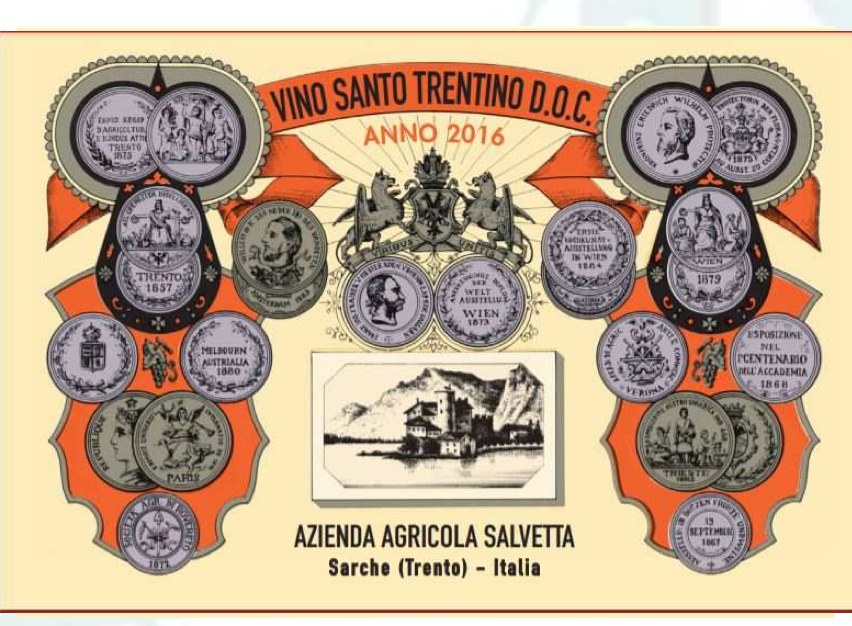
The nineteenth-century estate of Giacomo Sommadossi, castellan and “keeper” of Castel Toblino, made excellent wines in the cellar at Sarche (alla Posta), as a number of old documents and awards attest: the original 1881 diploma “FOR VINO SANTO PURO, 1825” of the Melbourne International Exhibition, Australia, to G. Sommadossi, Vienna, Austro-Hungary; further diplomas from Paris 1878, Trieste 1882, Amsterdam 1883 and Antwerp 1885; and handwritten labels from the Austrian production of the time.
The well-known German writer and poet Josef Viktor von Scheffel, travelling for pleasure in Trentino (then Tyrol) in 1855 with his friend the painter Anselm Feuerbach, stayed two months in the castle itself, and came to know and describe in detail Sommadossi — known as the Elder — and the Vino Santo he poured.
Azienda Agricola Rauten carries on the legacy of the Sommadossi estate, which Dario Salvetta — born in Bolognano d’Arco (Trento) in 1887, died in Sarche (Trento) in 1972, father of the present cellarman Giancarlo — bought in the early nineteen-thirties, bringing back the celebrated Vino Santo.
A fine sweet wine for meditation, with its characteristic notes of dried grapes, fruit and preserves, Vino Santo is best served at 12 to 14 degrees.
The label
Frequently asked questions
What is the Vino Santo of Trentino?
Vino Santo Trentino DOC: a passito from Valle dei Laghi, made from Nosiola grapes dried on the arele racks until Holy Week. It ferments through the summer into the autumn and ages in glass demijohns for at least 4 years. In Sarche its production is documented from 1550.
What is the difference between Vin Santo and Vino Santo?
They are two different wines with almost the same name. Tuscan Vin Santo is made mostly from Trebbiano Toscano and Malvasia grapes, dried and then aged for years in oak barrels or glass demijohns. Vino Santo Trentino DOC is made from a single grape, the Nosiola of Valle dei Laghi, dried on the arele racks until Holy Week and fermented for years in oak barrels. Ours is the Trentino one.
How much does a bottle of Vino Santo cost?
The vintages on sale, with prices, are in the online shop. The bottle holds 0.375 litres.
Where is Vino Santo made?
In Valle dei Laghi, in Trentino. The historical sources mention Castel Toblino, Calavino, Sarche and Santa Massenza; we make ours in Sarche, from the Rauten vineyard.